


Jung-Chieh Lee, Jiang Zixuan, Liangnan Xiong
International Journal of Information Management
https://www.sciencedirect.com/science/article/pii/S0268401226000332
JEL CLASSIFICATION
Q1
ABSTRACT
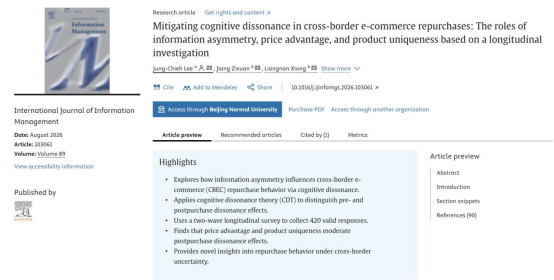
The emergence of cross-border e-commerce (CBEC) has led to the transformation of consumer shopping habits away from those of traditional domestic e-commerce. Information asymmetry is a prominent feature of CBEC and is important for understanding the impact of cross-border purchases. However, how information asymmetry affects the CBEC repurchase behavior of consumers has not been determined. To address this issue, in this study, cognitive dissonance theory (CDT) is applied to develop a research model by investigating the effects of information asymmetry on the repurchase behavior of consumers through cognitive dissonance before and after a purchase. Additionally, we consider two CBEC drivers, i.e., price advantage and product uniqueness, as moderators that contextually affect the model. A total of 420 valid responses were collected through a two-wave longitudinal survey. The data were analyzed via the partial least squares (PLS) technique. The results reveal that information asymmetry increases prepurchase and postpurchase cognitive dissonance, which in turn affects the CBEC repurchase behavior of consumers. In addition, price advantage and product uniqueness can effectively attenuate the negative impact of postpurchase cognitive dissonance on repurchase behavior. This study constitutes the first step in exploring the impact of information asymmetry on consumer purchase decisions in the CBEC context. This study contributes to the CBEC literature by providing a greater understanding of how information asymmetry affects the repurchase behavior of consumers from a CDT perspective.
KEYWORDS
Cross-border e-commerce (CBEC); Information asymmetry; Cognitive dissonance theory (CDT); Price advantage;Product uniqueness; Repurchase behavior
